

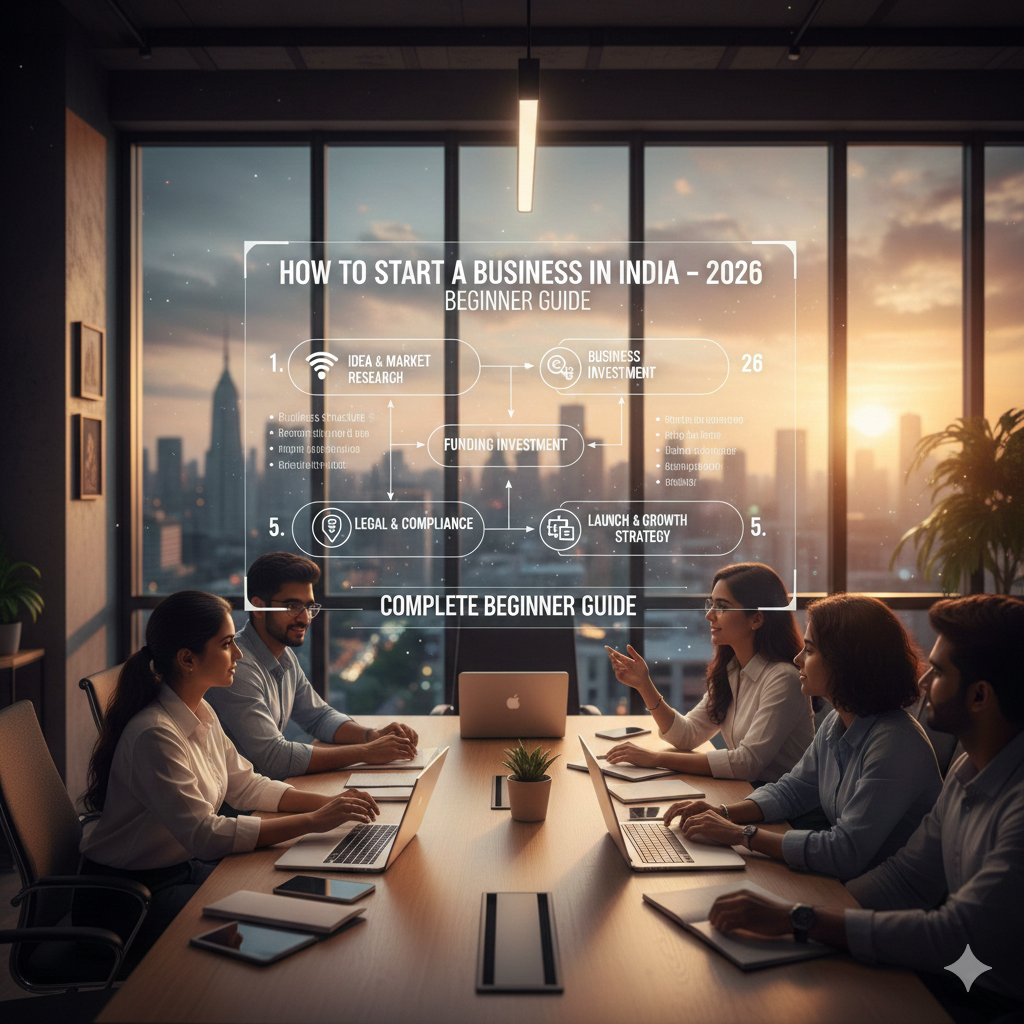
How to Start a Business in India in 2026 – Complete Detailed Guide
Introduction
Starting a business in India in 2026 presents one of the most promising opportunities in recent history. India’s rapidly expanding digital economy, supportive government policies, improved infrastructure, simplified compliance processes, and rising consumer demand have created a highly favorable environment for entrepreneurs. With increasing internet penetration, digital payments adoption, and the growth of Tier 2 and Tier 3 markets, the barrier to entry has significantly reduced. However, while starting has become easier, sustaining and scaling a business requires careful planning, financial discipline, market understanding, and strategic execution. This guide explains every major step in detail to help you build a successful and scalable business in India.
Step 1: Identifying a Profitable Business Idea
Every successful business begins with solving a real problem. The most common mistake aspiring entrepreneurs make is starting with a product instead of starting with a problem. A profitable business idea must address a specific pain point faced by a defined audience. Before investing any capital, it is essential to conduct thorough market research. This includes analyzing customer demand, understanding buying behavior, evaluating competitors, and estimating realistic profit margins.
In 2026, several sectors are witnessing high growth potential in India. AI-based services such as automation tools, chatbot solutions, and AI-powered marketing services are rapidly expanding. E-commerce and Direct-to-Consumer (D2C) brands continue to dominate due to the shift toward online shopping. Organic food, wellness products, and fitness-related services are gaining traction as consumers become more health-conscious. Digital marketing agencies and content creation businesses are also growing because businesses increasingly rely on online visibility.
Choosing the right niche is not about following trends blindly; it is about aligning market demand with your skills, resources, and long-term vision. Scalability should always be considered from the beginning.
Step 2: Creating a Strong Business Plan
A business plan is the blueprint of your venture. It transforms your idea into a structured execution model. Many small businesses fail not because the idea was bad, but because there was no structured planning.
A comprehensive business plan should clearly define your vision and mission. Your vision outlines where you want your company to be in the future, while your mission defines the purpose and value you offer. The plan must include a detailed target audience profile, specifying demographics, purchasing behavior, and market size.
Additionally, your revenue model must explain how the business will generate income. Whether through product sales, subscriptions, commissions, or services, clarity in revenue generation ensures sustainability. A cost structure analysis should identify fixed and variable costs, allowing you to calculate break-even points and projected profitability.
Marketing strategy is another crucial component. It should outline how you will acquire customers, retain them, and build brand loyalty. Investors and financial institutions often evaluate businesses primarily on the strength and realism of their business plans.
Step 3: Registering Your Business Legally
Legal registration builds credibility and protects your business from future disputes. In India, selecting the appropriate business structure depends on your scale, liability preference, taxation considerations, and long-term growth plans.
A Sole Proprietorship is suitable for small, low-risk businesses and offers simple compliance. A Partnership Firm allows shared responsibility between partners but carries shared liabilities. A Limited Liability Partnership (LLP) provides liability protection while maintaining operational flexibility. A Private Limited Company is ideal for scalable startups seeking investor funding, as it offers structured governance and limited liability.
Registration is completed through the Ministry of Corporate Affairs (MCA) portal. After incorporation, additional registrations such as GST Registration, MSME (Udyam) Registration, and Startup India recognition (if eligible) should be obtained. These registrations provide tax benefits, easier access to loans, and government incentives.
Legal compliance not only protects the business but also increases trust among customers and investors.
Step 4: Arranging Funding and Financial Planning
Capital is the fuel of a business. Without adequate funding, even strong ideas struggle to survive. The funding requirement depends on your business model, operational scale, and growth strategy.
Bootstrapping through personal savings allows full control but may limit expansion speed. Bank loans provide structured funding but require strong documentation and repayment planning. Government schemes under initiatives like Startup India and MSME programs offer financial assistance and subsidies to eligible businesses.
For scalable startups, angel investors and venture capital firms provide large capital in exchange for equity. However, this requires a strong business model, traction, and growth potential. Crowdfunding platforms also offer alternative financing by collecting small investments from a large audience.
Effective financial management includes budgeting, cash flow monitoring, and maintaining emergency reserves. Profit should be strategically reinvested into marketing, technology, and expansion.
Step 5: Building a Strong Online Presence
In 2026, digital presence determines business visibility. Consumers search online before making purchasing decisions, which makes online branding essential.
The first step is creating a professional website that clearly communicates your products or services. The website should be optimized for search engines (SEO) to ensure visibility on Google. Keyword optimization, high-quality content, fast loading speed, and mobile responsiveness significantly impact rankings.
Social media platforms such as Instagram, LinkedIn, and YouTube help build brand awareness and customer engagement. Paid advertising through Google Ads and Meta Ads accelerates reach and lead generation. Email marketing and marketing automation tools help nurture long-term customer relationships.
Businesses that combine organic marketing strategies with paid campaigns often achieve faster and more sustainable growth.
Branding and Customer Experience
Beyond operations and marketing, branding plays a decisive role in long-term success. A strong brand identity includes logo design, consistent color schemes, messaging tone, and value positioning. Premium brands focus on quality perception, customer trust, and emotional connection.
Customer experience should remain a top priority. Fast support response, clear communication, transparent policies, and after-sales engagement build loyalty. In competitive markets, customer retention is often more profitable than constant new customer acquisition.
Conclusion
Starting a business in India in 2026 is an opportunity filled with potential, but success depends on preparation, discipline, and adaptability. A profitable idea, supported by a structured business plan, proper legal registration, strategic funding, and strong digital presence, forms the foundation of a scalable enterprise.
Entrepreneurship is not about immediate results; it is about consistent execution and long-term vision. With smart planning and commitment, even small beginnings can grow into powerful brands in India’s expanding economy.
Hi, this is a comment.
To get started with moderating, editing, and deleting comments, please visit the Comments screen in the dashboard.
Commenter avatars come from Gravatar.
[…] vs Private Label in 2026 – Which Business Model is […]